Nine Eco Friendly Houseboats

Written by Cathy on September 30, 2009 – 5:40 am -

Welcome back!

I have for years always wanted to live on a houseboat-and thought I would look into the availability of sustainable and Eco- Friendly Houseboats: Pretty incredible designs and now I really want to live on a houseboat!

The Solar Houseboat Home by Mark Kingsley Architects.

The Solar Home- Eco Friendly Houseboat Design

The Schwimmhaus by Confused Direction Firm- in Oldenburg, Germany

Schwimmhaus

Dome-Shaped Solar Powered Boathouse by Orhan Cileili.

Solar Powered Houseboat by Orhan Cileli

The PreFab Sustainable Metro Ship by David Ballinger.

Metro Ship by David Ballinger

The Arctic Houseboat by Covey Island Boatworks.

Arctic Houseboat with Solar Energy

Reuse Old Planes- Cosmic Muffin in Ft. Lauderdale

Cosmic Muffin Boeing 307 Houseboat

Modern Houseboat by Niall McLaughlin Architects

Modern Houseboat by Niall McLaughlin Architects

Watervilla- by WaterStudio in the Netherlands

Watervilla

Sustainable Floating Cabin in British Columbia

Resources

Articles on Pollution and Houseboats


Tags:
Posted in Building | 1 Comment »

The Importance of Recycling Prosthetic Limbs

Written by Cathy on September 29, 2009 – 5:30 am -

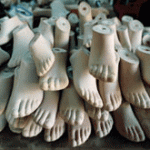
Donated Feet

I Just Gotta Tell Ya

  • 70 landmine-affected countries and six other mine-affected territories not internationally recognized. To see a list of these countries click here. Afghanistan and Cambodia, are some of the most affected countries.
  • In 2001- over 300 people a day were hurt by land mines every month in Afghanistan
  • Estimated number of land mines in Afghanistan are from 5-10 million
  • Landmines kill or injure two Cambodian people every day. In areas which have been mined, land cannot be used for farming – so food production suffers.
  • United Nations reports that “the number of units of blood required to operate on patients with mine injuries is between 2 and 6 times greater than that needed by other war casualties

How To Recycle Prosthetic Limbs

Amputee Coalition of America, states “Prosthetic components are generally not reused in the United States because of legal considerations. However, used prosthetic limbs may be disassembled and the components shipped to Third World countries for use by landmine victims and/or other individuals in need.” See their Website for a list of organizations in the U.S. that accept donations of prosthetics.

Where to Recycle Prosthetic Limbs

Ability Prosthetics & Orthotics 455 South Washington Street, Suite 11  Gettysburg, PA 17325  717/337-2273  http://www.abilitypo.com

  • Ability Prosthetics and Orthotics has teamed up with Physicians for Peace.  Their goal is to collect old prosthetic parts and ship them overseas so that more amputees will have greater access. They will accept prosthetic donations at all their facilities in Maryland and Pennsylvania.

Angels with Limbs 289 Broadway Long Branch, NJ 07740 732/222-2500 http://www.angelswithlimbs.org

  • (New Jersey only) Angels with Limbs is a charitable, non-profit corporation soliciting unused artificial limbs so as to recycle their usable prosthetic components in fabricating a new prosthesis for needy un-insured or under-insured New Jersey amputees.

Barr Foundation c/o MedShare International  3240 Clifton Springs Road, Decatur, GA 30034 561/391-7601   http://www.oandp.com/resources/organizations/barr

  • This fund pays for materials and fitting of a new prosthesis after the prosthetist has established that there are no other sources of funding available. The Barr Foundation also accepts monetary, used and new prosthetic devices and components, and will acknowledge all donations with our federal non profit federal tax identification number for your tax purposes. Please call or e-mail the Barr Foundation for further information

Bowman Siciliano Limb Bank Foundation 100 Spanish Oak RD,  Weatherford, TX 76087 817/597-1826 http://www.danabowman.com/danabowman122006_032.htm

  • This Foundation collects and distributes all forms of prosthetic limbs to those in need. They collaborate at times with other foundations to assist in countries outside the U.S. and prosthetic labs across the U.S. They raise funds to provide transportation, lodging, and prosthetic limbs and services to those in need.

The International Foundation for the Physically Disabled 2795 E BidwellST Suite 100 #245 Folsom, CA 95630 916/990-8313 or 866/542-5854 (toll free) http://www.theifpd.org

  • It is the primary mission of The International Foundation for the Physically Disabled (IFPD) to provide necessary and appropriate prostheses, orthotics and durable medical devices for various individuals of limited financial means, as well as victims of war and the disabled in third world & developing countries.

Limbs for Life Foundation 5929 N May, STE 511 Oklahoma City, OK 73112 405/843-5174 or 888/235-5462 (toll-free) http://www.limbsforlife.org

  • Thanks to the World Limb Bank, the Limbs for Life Foundation is able to collect and distribute used prosthetics and prosthetic componentry free of charge to amputees in third world countries. Parts are utilized to create prostheses for their recipients, thus reducing the costs for the prosthetist. They also accept unused socks or liners.

Limbs of Hope Foundation 6782 S Dixie DR West Jordan, UT 84084 801/548-0553 http://www.limbsofhope.org/resources.html

  • The Limbs of Hope Foundation accepts new and used prosthetics that are to be sent across the globe in hopes of bettering the quality of life for those in need. They also provide recreational opportunities and recreational equipment for underdeveloped countries, as well as remodeling clinics in countries torn by war and/or illness.

Limbs of Love 1000 S Loop West STE 150 Houston, TX 77054 713/747-7647 http://www.limbsoflove.com/

  • Limbs of Love utilizes the time, skills and resources of medical professionals and manufacturers who receive no remuneration in an effort to improve the overall quality of life for amputees, primarily in Texas. Through the support of The Amputee and Prosthetic Center, prosthetic manufacturers, and medical personnel from the Houston area, Limbs of Love will be donating as many as 20 prosthetic limbs with a value of over $250,000 to those who have suffered the loss of a limb and have been previously turned away.

Michigan Society to Advance Rehabilitation, Inc. (M-Star) 4973 E Ten Mile RD, #7 Warren, MI 48091 586/295-0321 http://m-star.org/donations.htm

  • M-STAR provides peer support and aid to those who have lost one or more limbs either through traumatic or surgical amputation. M-STAR is set up for the good of the public and not for private profit. It is a non-commercial endeavor to aid amputees.

National Amputation Foundation 40 Church ST Malverne, NY 11565 516/887-3600 http://www.nationalamputation.org

  • The National Amputation Foundation (NAF) has for over 80 years been offering valuable assistance to veterans of World War I, II, Korea, the Vietnam Conflict, Desert Storm and Iraqi Freedom. Since then, the Foundation has expanded its facilities to include civilian amputees as well.

Physicians for Peace 229 W Bute ST, STE 200 Norfolk, VA  23510 757/625-7569, ext. 326 http://www.physiciansforpeace.org/site/PageServer?pagename=donations

  • Physicians for Peace is an international, humanitarian, non-profit, medical education organization dedicated to building peace and international friendships in developing nations with unmet medical needs and scarce resources. Donations of medical supplies and equipment are greatly valued.

The Prosthetic and Orthotic Component Clearinghouse MedShare International c/o P.O.C.C. 3240 Clifton Springs Road Decatur, GA 30034 http://usispo.org/pocc/

  • The POCC was launched in July 2007 as a collaborative project between MedShare International and the U.S. National Member Society of ISPO (US-ISPO). The aim of the Prosthetic and Orthotic Component Clearinghouse is to provide a mechanism for people to make tax deductible donations of new and gently used prosthetic and orthotic goods while in turn affording non-governmental organizations (NGOs), P&O practitioners, and developing world schools and facilities access to these badly needed supplies.

Volunteers for Inter-American Development Assistance (VIDA) 6251 Hollis ST Emeryville, CA 94608 510/655-8432 http://www.vidausa.org

  • VIDA is a nonprofit medical relief and development assistance organization based in Emeryville, CA. Since their foundation in 1991, they have provided nearly $40 million in medical aid to eleven countries in Latin America. They are currently attempting to acquire prosthetic limbs for victims of landmines.
Resources
  • Amputee Coalition of America- Fact Sheet on recycling Prosthetic Limbs and where to donate.
  • Journal of Mine Action- Victim Assistance
  • Mines Action Canada-
  • US  Policy on Mine Removal in Afghanistan
  • Cartagena Summit- www.CartagenaSummit.org
  • Anti Personal Mine Ban Convention Implemention Support www.apminebanconvention.org.-Seeks to eradicate the use, production, stockpiling, transfer and the destruction of mines across the world
  • World Vision’s Advocacy site http://www.worldvision.com.au/getinvolved/advocacy
  • The International Campaign to Ban Landmines http://www.icbl.org/
  • The International Campaign to Ban Landmines site for young people http://www.icbl.org/youth
  • The International Campaign to Ban Landmines ambassadors’ site http://www.icbl.org/amb/
  • Mines Advisory Group http://www.mag.org.uk/
  • Demining Research at the University of Western Australia http://www.mech.uwa.edu.au/jpt/demining/
  • Mine Action Information Centre at James Madison University, USA http://www.maic.jmu.edu/
  • The United Nations Mine Action Service http://www.mineaction.org/

Tags: , ,
Posted in Recycle | No Comments »

San Diego Recycling and Composting Updates

Written by Cathy on September 28, 2009 – 8:41 am -

SAN DIEGO – Mayor Jerry Sanders announced on Tuesday that San Diego’s recycling rate was 64 percent in 2008, the highest number since the city began keeping such records in the early 1990s.

Of the nearly 4.1 million tons of trash generated in San Diego last year, about 2.6 million got diverted from landfills.

In 2006, the city’s recycling rate was 55 percent.

City officials said the recent rise is due to outreach efforts and new ordinances that have raised interest in separating items such as plastics, glass bottles and newspapers from the rest of the garbage.

They also said residents have become more cost-conscious amid the recession, reusing more items instead of throwing them away and redeeming recyclable cans and other products that put money back in their pockets.

“All San Diegans deserve credit for taking the message of recycling to heart,” Sanders said during a news conference at the city’s Miramar Landfill.

On Another Eco- Note

Tuesday, Sept. 22, 2009 | Chicken tacos and chili cheese fries are on the menu tonight at Point Loma Nazarene University.

After dinner, the school’s dining staff will scrape every last half-eaten taco and congealed fry into a black bin full of food waste, destined for a small plot in the city-owned Miramar Landfill where compost is made.

Instead of getting buried with the rest of the city of San Diego’s garbage, those table scraps will be rich soil in about 10 weeks, ready for residents to pick up and spread on their gardens at home.

As San Diego residents continue increasing their recycling efforts, the city says programs like Point Loma’s that divert food waste from the landfill will be the next frontier for extending the facility’s life and boosting the city’s recycling rate. The university is one of just seven large local institutions that recycle food waste at the landfill.

Today, San Diegans are keeping an estimated 64 percent of their garbage from winding up in the dump. Mayor Jerry Sanders announced the figure Tuesday from behind a podium surrounded by two blue recycling bins atop the landfill. The recycling rate, up from 55 percent in 2006, estimates how much waste is recycled, reused or diverted from the landfill.

Sanders credited the increase to new city laws that have made recycling mandatory for single-family homes, all special events and most apartment complexes and businesses. Previously, large apartments and offices owners didn’t have to provide blue bins

The mayor, who initially opposed citywide mandatory recycling efforts in 2007, lauded the new laws for making San Diego “one of the nation’s most progressive cities on this important issue.”

San Diego wasn’t a leader in adopting the rules. Most local cities instituted mandatory recycling efforts nearly two decades before San Diego did. And other California cities such as San Francisco, San Jose, Anaheim and Los Angeles allow residents to recycle yogurt cups, plastic utensils and compact disc cases. San Diego doesn’t.

The increased recycling efforts, along with a decrease in dumping associated with the economic downturn and a Marine-approved increase in the landfill’s height limit have combined to extend the landfill’s estimated closure date to 2019, said Chris Gonaver, director of the city’s Environmental Services Department. The city had previously estimated the landfill would close as early as 2012. That would require the city to pay private landfill owners to dump the trash it collects.

San Diego’s recycling rate has steadily increased since the city began tracking the figure. State law requires cities like San Diego to keep at least 50 percent of residents’ waste out of the landfill or face fines. But as the state Legislature weighs laws that could increase that requirement to 75 percent, the city is also looking for ways to continue boosting the figure.

Enter food recycling. City recycling officials say they plan within a year to triple the amount of food waste they can compost at the landfill. The city currently composts about 2,000 tons of food annually.

“For us, it’s the next opportunity,” said Ken Prue, a city recycling specialist.

The city today gets food waste from just seven sources: Point Loma, San Diego State, Petco Park, the Convention Center, the Marine Corps Recruit Depot, Del Mar Fairgrounds and Sea World.

SDSU collects food scraps at three sites on campus, including its main cafeteria. Kitchen staffers dump their prep materials (such as orange peels) in composting bins and scrape students’ plates, too.

“We want to be on the cutting edge of sustainability and recycling,” said SDSU spokeswoman Gina Jacobs. “It’s a high priority for us.”

While the city collects 2,000 tons from SDSU and those other large sources, an estimated 140,000 tons of food waste from homes, businesses and other large institutions is dumped in the landfill each year. That’s about 20 percent of the total waste stream.

Students at University of California, San Diego eat 3 million meals on campus annually and create an estimated 5 tons of food scraps daily. The university, which aims to divert 75 percent of its waste from the landfill by 2012, has had separate composting bins at its dining facilities for the last year. But the city’s composting program hasn’t had enough capacity to take UCSD’s scraps, so the school’s food waste gets dumped in the landfill.

Krista Mays, UCSD’s sustainability manager for housing, dining and hospitality, said the composting program launched on campus in anticipation of the city’s expanded capacity for collecting food scraps. She wants to get students in the habit of separating their food from other garbage.

“The minute we can get it into the food scrap composting, we’ll do it,” Mays said. “Food scrap is not an easy catch, but it’s definitely worth the effort.”

Please contact Rob Davis directly at rob.davis@voiceofsandiego.org and follow him on Twitter: twitter.com/robwdavis. And set the tone of the debate with a letter to the editor.


Tags: ,
Posted in California | 1 Comment »

Kids Konserve Renewable Lunch Bags- Save 15%

Written by Cathy on September 28, 2009 – 8:35 am -

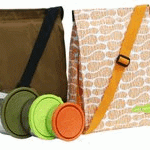
Kids Konserve Eco Friendly Lunch Bags

A fairly new company, Kids Konserve is creating awareness via their Waste-Free Lunch Challenge Fundraiser and teaching kids about how not to create waste, Kids Konserve can help lead to a major savings in our landfills, greenhouse gases and your wallet. Many schools do not even recycle, and the amount of trash produced by one child’s lunch alone creates 67 pounds of landfill waste in a school year! Kids Konserve offers its reusable lunch products directly to families as well as a fundraising opportunity in schools. Kids Konserve products are Non-Toxic, Non-Leaching, BPA,PVC, Phthalate, and lead-free!

The insulated lunch bags are made from 100% recycled plastic water bottles/Petspun. The nesting trio are 304 food grade stainless steel containers that are all the right sizes

To order and receive your 15% discount use coupon code greeneco- valid through 10/31/09


Tags:
Posted in Family | 1 Comment »

Newsweek Rates Green Companies in America
Written by Cathy on September 27, 2009 – 7:58 am -

Newsweek undertook a green rating project- which rated public companies not on their carbon footprint but their corporate policies. The top 10

  1. Hewlett-Packard Company- recycled 265 million pounds of electronics.
  2. Dell Inc.- in a partnership Goodwill- collects and recycles electronics nationwide.
  3. Johnson & Johnson
  4. Intel Corporation
  5. IBM
  6. State Street Corporation
  7. NIKE, Inc.- Introduced Trash Talk Shoe Line and recycled old tennis shoes.
  8. Bristol-Myers Squibb Company
  9. Applied Materials, Inc.
  10. Starbucks Corporation- I don’t believe this- especially after my rant- but it’s on the list.

Tags:
Posted in Business | No Comments »

Reuse Skateboards-Wall Art by Landyachtz Longboards

Written by Cathy on September 25, 2009 – 8:23 am -

Skateboard Deck Art by Landyachtz

At the Action Sports Retail Show- I asked all of these sporting exhibitors- the big question- what do they do with their old, used and blemished products? (Response)- ‘Yo, dudette, we give them away, we make shelves,’ yo dudette, we like make all sorta stuff…”- I begged- send me pics on reusing, recycling, and guess what- Landyachtz Longboards just sent me this wall art, combination of moose antlers- soaring eagle look out of blemished skateboard decks. (sorry the pic is small- I could not enlarge it) The antler art was made by local artist JoshVandyke.

Landyachtz is one of the eco-friendly sustainable Action Sport Companies, striving to reuse and recycle all products and waste. Much of their office is salvaged materials- they do much of the work themselves. They feel (and it’s true)  if they make a superior quality product that is built to last- and doesn’t break (and pops too!) that less skateboards will land up in landfills- you can own and use your skateboard in years to come.

I don’t know that much about skateboards, except I believe the last time I was on one was probably 45 years ago (old enough to be the founders mothers). But I do know this- support those who support the environment- and these guys (dudes) are definitely on the right track- I look forward to getting more recycle and reuse pics from them.


Tags: , ,
Posted in Sports | No Comments »

Recycling Hair For Oil Spills and Fertilizer

Written by Cathy on September 24, 2009 – 6:25 pm -

Recycle Hair Into Hairmats

I Just Gotta Tell Ya

  • 2008 – over 2600 oil spills world wide in 2008
  • Hair dressers collect an average of 1 pound of hair clippings a day

Where to Recycle

  • Locks of Love- Takes human hair donations to recycle into hairpieces for disadvantaged children who suffer from medical hair loss.
  • Little Princess Trust (UK) Takes human hair donations and produce wigs for children with medical hair loss.
  • Matter of Trust in San Francisco- recycles hair into Hairmats for oil spills. The site offers ways you can recycle your hair and clean up your own oil spills (garage)
  • Compost In Your Garden- Your hair is full of nitrogen- very good for plants. If you don’t have a composter, spread it around the yard and it will help keep away rodents and snails.
  • Spread it in Trees- Birds will pick up the hair to make nests.

Resources


Tags:
Posted in Recycle | No Comments »

Recycling Sex Toys

Written by Cathy on September 23, 2009 – 6:13 pm -

I haven’t gone over the deep end- but all those sex toys and adult novelties use batteries and other e-wasteful materials. Several places offer Recycling Services:  Sex Toy Recycling is taking used toys and recycling the materials into new offerings. Not only that they are remade in America- supporting our local economy.

Sex Toy Recycling Program offers an incentive program of a $10 gift card for every package of toys sent in. They are also certified by Institute For Green Business.

It makes sense-  many of the materials used are toxic and non-biodegradable containing Phthalates.(oil derived chemicals)   So if you are bored with your adult novelties- looking for something new and even looking for a gift contact Sex Toy Recycling. Oh they are not the only  Eco Friendly Sex Toys- Earth Erotics -also has offerings including recycled rubber whips, organic materials.

Resources


Tags: ,
Posted in Recycle | No Comments »

Recycling Hotel Soap For World Health

Written by Cathy on September 22, 2009 – 8:50 pm -

I have always wondered what happens to all the leftover slivers of hotel soap, the half bottles of shampoo and other bath items. Because it’s such a waste, I usually bring it home and continue to use it until it’s gone. Why waste? What I didn’t know is that an organization Clean the World takes leftover soap and shampoo and donates it to the needy. Another organization called Global Soap Project also sends soap overseas. To keep it local donate to your local shelter.

I Just Gotta Tell Ya:

  • 93,349 Hotels and Motels in the USA alone.
  • The average hotel has 200 rooms and 4 Million Rooms per night Globally
  • Soap is crucial in combating diarrhea- with over 2 million people die from diarrhea every year.
  • Millions of bars of soap and slivers land up on landfills and our groundwater

What can you do?

  1. Donate any unused soaps to the above organizations or your local shelter.
  2. Recycling Soap Scraps into new soaps
  • Stretcher- Good Recipes and uses for Soap Scraps
  • Bright Hub- Recycling Soaps into Guest Soaps

Tags:
Posted in Recycle | No Comments »

Starbucks Recycles- Big Wow-Big Yawn- Another Me-Too

Written by Cathy on September 22, 2009 – 8:39 am -

I am anti-Starbucks- because I think they are the biggest green hypocrites. I cannot tell you how many Starbucks coffee cups and lids are littered all over the streets. It’s not Starbuck’s fault that people litter- but they could do something about it such as big signs posted in their stores about recycling cups and lids- a sign that states’ please do not use lids if you don’t need them’- They could put recycling bins in the stores and the strip centers they operate out of. They could encourage people to bring their own mugs- not a measly $.05 cents off a cup of coffee for bringing your own mug. Their cups could be recyclable, they could have their staff picking up litter and participating in litter clean ups, since so much of the litter is theirs.

I read about how they opened up a store using reclaimed materials (another yawner), using solar energy (another me-too) not once, do you read about them picking up litter- which is more hazardous and toxic than opening 1 store using reclaimed materials.

I Just Gotta Tell Ya

  • 2.3 Billion paper cups are used by Starbucks
  • Currently, 58 billion paper cups are used in restaurants, events and homes in the U.S. each year. According to a Global Green press release, “If all paper cups in the U.S. were recycled, 645,000 tons of waste would be diverted from landfills each year, reducing greenhouse gas emissions by 2.5 million mtCO2e, equivalent to removing 450,000 passenger cars from the road.”
  • Landfills are the final resting place for three billion Starbucks coffee cups annually. The polyethylene coating that lines and seals the inner cup makes the perfectly repulpable paper non-recyclable.

Here is Starbucks Social Responsibility Statement

CORPORATE SOCIAL RESPONSIBILITY

‘At Starbucks, we strive to be a great enduring company by championing business practices that help produce social, environmental and economic benefits for the communities in which we operate. Starbucks focuses its efforts on providing a great work environment for our partners (employees); making a positive contribution to our communities; working with coffee farmers to help ensure their long-term success and minimizing our environmental impact. ’

So now that it is the ‘in thing’, 7 stores in Manhattan will start recycling. Big Wow! I mean really, litter has been an issue for over 500 years, and hardly anyone can walk down a street without seeing Starbucks litter. Coffee lids have been a problem for years- a problem that Canada is considering charging $.20 for coffee cup lids. Can you really tell me the people at Starbucks don’t see their coffee containers in the streets?

The last Starbucks I was in- about 1 month ago- carried only 1 organic coffee and no Fair Trade coffee. I asked the staff and THEY DIDN’T KNOW WHAT FAIR TRADE WAS. Unbelievable, especially when Starbucks talks about how they train their people and how ‘environmentally sensitive they are.

Are the Cups even recyclable? A post from Organic Consumers -’The sleeves on the cups even plead, “Help us help the planet.”  But don’t be confused. Starbucks promotes recycling on its cups, but the cups themselves aren’t recyclable here or in most other cities nationwide. ”Well, they tricked me,” said Nicole Mejias, 22, a self-described Starbucks freak. “I immediately associate recycling with Starbucks because of their cups. That’s so hypocritical. I would have never guessed” that the cups weren’t easily recyclable.

The reason: The plastic coating that keeps the cup from leaking also prevents it from being recycled with other paper products. That could be overcome, but it would cost more.  Anything can be recycled, but “The system is not designed to take the individual Starbucks cups,” said Steve Sargent, director of recycling for Rumpke Recycling, Columbus’ largest recycler.

Waste Management, North America’s largest recycler, won’t take the cups, either. But many employees have been telling customers otherwise. They say their Seattle-based employer never made the situation clear.

“I totally thought the cups were recyclable. I think almost everyone did,” said Melanie O’Brien, an Otterbein College student studying environmental initiatives who has worked at Starbucks. Recently, workers at a Clintonville Starbucks started taking cups to recycling sites themselves, because they felt guilty that they were being thrown away.

But an employee from the Solid Waste Authority of Central Ohio informed them that their efforts were pointless because recyclers would accept neither their plastic nor paper cups. An official with the Ohio Division of Natural Resources commended Starbucks for using recycled materials, but said the company is missing a bigger point…… Starbucks cups aren’t compostable, and the company doesn’t offer free reusable cups. But it sells travel mugs and offers a 10-cent discount to customers who bring their own cups.

Customers in the United States and Canada took that offer more than 17 million times in 2006, saving 674,000 pounds of paper, said Starbucks spokeswoman Valerie Carlborg. Starbucks said that a more-recyclable cup wasn’t an option, but the cup manufacturer disagreed. ”It’s all about the money; the question is whether they would be willing to pay for it,” said Kelvin Okamoto, manager of materials and engineer at SOLO Cup Co., which is based in Illinois.  Making that change could double the cost of cups, he said, “which means consumers would likely have to pay more, too.”

If Starbucks really wanted to be sustainable- Here is what they should do:

  1. Charge $1.00 for the cup and $.25 for the lid. $.25 for the brown wrap and $1.00 for the coffee.
  2. Post Big Sign- Please Recycle lids and cups-
  3. Put litter facts on their cups and signage.
  4. Place Recycle Bins through out strip Centers or around area where their store is.
  5. Have staff be responsible for litter pick up in 2 block radius of store
  6. Have community litter pick up events.
  7. Quit worrying about their solar energy- it benefits all in the long run-but will bring down their overhead and they will not pass the costs on to the consumer.
  8. Convert to fully recyclable cups and lids

Again, I repeat Starbucks is not responsible for people littering. They could make it easier to recycle their products, they could pass on litter facts, they could live up to their corporate sustainability statement, they could encourage and reward people for recycling and picking up trash- they could be a leader again instead of a follower. When that happens- I will again start to support Starbucks.


Tags: ,
Posted in Pollution | No Comments »