
Tarzan Tico Costa Rica’s Crocodile Man
Written by Cathy on November 30, 2009 – 12:27 pm -

Welcome back!

croc-500x293

Chito prefers a playful wrestle in the water with his best pal Pocho - a deadly 17ft crocodile

IF you thought the legend of the horse whisperer was impressive, here’s an animal tale with even more bite. Chito wrestles in the water with best mate Pocho, a five-metre long crocodile, Chito and Poncho play in the water together

Rather than trying to tame wild stallions, fearless Costa Rican fisherman Chito prefers a playful wrestle in the water with his best pal Pocho – a deadly 17ft crocodile. The 52-year-old daredevil draws gasps of amazement from onlookers by wading chest-deep into the water, then whistling for his 980lb buddy – and giving him an affectionate hug.

Crazy Chito says: “Pocho is my best friend. This is a very dangerous routine but we have a good relationship. He will look me in the eye and not attack me. It is too dangerous for anyone else to come in the water. It is only ever the two of us.” …  more from Costa Rica’s Crocodile Man


Tags:
Posted in Eco Tourism | No Comments »

Naked Juice reNewabottle Works to Keep America Clean

Written by Cathy on November 29, 2009 – 7:29 am -

As much as I hate plastic, I give Naked Juice a lot of credit for their reNewabottle, which is 100% recycled and 100% recyclable plastic bottle. The new bottle is called Naked Message in a Bottle and they will donate $1.00 every time a Naked Bottle is passed on via their Facebook Application. Pass a bottle on Facebook:http://apps.facebook.com/messageinabottle.

The best part is they will donate up to $20,000 to Keep America Beautiful, one of my favorite non-profits. Keep America Beautiful works to reduce litter and trash on Americas Roadsides.


Tags: ,
Posted in Food and Drink | No Comments »

Babies Crawl To Protest Toxic Ingredients In Household Products

Written by Cathy on November 28, 2009 – 8:48 am -

Seventh Generation is launching a Million Baby Crawl to Washington to protest toxic ingredients in household cleaning products.

I Just Gotta Tell Ya

  • Of the 80,000 plus chemicals, only 200 have been tested by the EPA
  • In 2006, poison control centers reported about 2 Million unintentional poisoning.
  • U.S Poison Control Centers- A child is accidentally poisoned every 30 seconds at home.
  • The Average American uses about 25 Gallons of toxic hazardous chemical products per year in their home.
  • The toxic chemicals in household cleaners are 3x more likely to cause cancer than air pollution.

For more information go to Seventh Generation.com


Tags: ,
Posted in Clean and Non-Toxic | No Comments »

Cost of Illegal Dumping in Imperial Valley- $7.5 Million

Written by Cathy on November 25, 2009 – 10:22 am -

01-main- IV

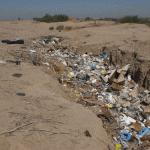
PHOTO COURTESY OF THE IMPERIAL IRRIGATION DISTRICT This is one of 15 illegal dumping sites that litter about 1,000 acres of Imperial Irrigation District property near canals. Hazardous materials, like discarded pesticide containers, increase waste-removal fees

For many of my readers, I have done so many posts on litter and illegal dumping.  Not only is it unsightly and toxic, it cost you the taxpayer money. Who else is going to clean it up.

The Imperial Irrigation District, about 1,000 acres has identified 15 illegal dump sites around the Alamo and New Rivers- that means that toxic waste is seeping into our groundwater. Estimated cost $7.5 million.

Read the full article here: IV press online


Tags: ,
Posted in California | 1 Comment »

Free Reclaimed Wood in Memphis, Tennessee

Written by Cathy on November 23, 2009 – 7:48 pm -

I received and email with this important announcement: If you are looking for reclaimed wood for building or crafts, this is a great opportunity and I can’t believe they are throwing this wood into the dumpsters!

There is a warehouse(Orgill Bros.) at Latham and Mallory in Memphis, Tn. that is getting rid of all of their old shelving. there are tons of old fir and pine going into dumpsters


Tags: ,
Posted in For Sale/ Wanted | 3 Comments »

Wash Your Car With Only One Glass of Water

Written by Cathy on November 23, 2009 – 7:44 pm -

Newport Beach, CA, November 16, 2009 -¬ Pierrick Bouquet today announced the launch of Ecolo Green Car Wash, offering an alternative to the environmentally un-friendly traditional car washes, which waste a tremendous amount of water and generate hazardous waste. Ecolo Green Car Wash has created a line of eco-friendly, biodegradable, non-toxic products to clean a variety of vehicles including cars, motorcycles, and boats. Using these products, Ecolo Green Car Wash currently provides its services in Southern California and is looking to expand to Northern California and other states.

Wasting water is no longer just bad for the environment. The truth is, it¹s bad for your pocket and for your self-image too. Take for example, cities like Pasadena and Los Angeles, where fines have recently been enacted for water wasters. If you are found hosing down your driveway instead of sweeping it with a broom, or watering your landscaping during certain hours of the day, or if the water police sees toxic runoff while you wash your car at home, you better be ready to cough up $100–not to mention the loss of a little bit of your dignity.

The trend in regulating water waste is now present in San Diego County, Riverside County, Orange County and Long Beach, where regardless of whether you are a motorist, business, or a gardener doing some outdoor watering, if you are not frugal with this precious resource, you could be fined and lambasted as an uninformed Californian caught committing a socially unacceptable act.

Why the recent crackdown on water use? Early this year Gov. Arnold Schwarzenegger declared a statewide drought in response to three years of below-average rainfall and snowfall and increasingly low reservoir levels. We are facing a serious water crisis, yet more than 100 millions of gallons of water are still wasted every day to wash cars in California.

Ecolo Green Car Wash is a response to this problem, providing services that use the equivalent of JUST one glass of water to wash a car. Ecolo Green Car Wash has become a progressive business in water conservation, replacing professional car washes with mobile teams that wash cars at business sites, and offering the Ecolo waterless car wash products for use at home.

All Ecolo Green Car Wash products are eco-friendly, economical, and easy to use. The main product, ECOLO-CAR, is a water-based, coconut soap and organic polymer blend that can be used on every surface of your vehicle without additional use of water. Once the product is sprayed onto your vehicle, organic polymers dissolve and lift the dirt from its surface. The residue is wiped off with a micro-fiber cloth, the surface is buffed, and your car is left with a beautiful shiny finish and protective glaze.

Currently Ecolo Green Car Wash provides its services to Oakley and Sole Technology in Lake Forest, companies committed to becoming environmental leaders, and The Irvine Company, covering several businesses centers in Irvine. These companies have realized we really can¹t afford to waste any more water. Now is the time to save face and save money, so get water-wise and ecolo-savvy.

CONTACT:

Pierrick Bouquet – President

ECOLO GREEN CAR WASH LLC

pierrick@ecologreencarwash.com

949 887 9732

http://www.ecologreencarwash.com


Tags: , ,
Posted in Wasted Water | No Comments »

Jack Johnson’s Song The 3R’s A Fun Recycle Song

Written by Cathy on November 18, 2009 – 9:31 am -


Tags:
Posted in Art | No Comments »

Good and Bad-Re-Building with Shipping Containers

Written by Cathy on November 16, 2009 – 8:15 pm -

Shipping Container Home by Adam Kalkin

I love the shipping container building that is going on. Upcycling these containers is a new hot trend in reused and salvaged building supplies. (See articles: Thinking Out the Box- Shipping Containers and Shipping Container Homes in Costa Rica

Due to several comments about the use of shipping containers I found this excellent article from sincerelysustainable.com with a little more depth in the use of using containers as building materials.

Shipping, or cargo, containers are probably the most widely used and almost completely ignored structures in the world. The majority of the imports countries consume arrive via shipping containers. Subsequently, there are literally millions of these containers on ships and in ports around the globe. Though it’s becoming an ever increasing trend to repurpose these containers for use as modular building materials, very rarely do you see it being done in a way that is either aesthetically pleasing and/or, in simple terms, ‘makes sense’ for the project itself, i.e. using containers as building elements then applying convoluted and expensive materials and techniques to hide the fact that containers are being used as the structural elements.

A Very Cool Container Building

A newly completed 3 story exhibition and artists’ studio space in Soul, Korea not only utilizes shipping containers for 95% of its structure, but makes no attempts at hiding the fact that it does. The building in question serves as the Asian ‘headquarters’ or ‘program space’ for the subcultural arts organization PLATOON who are a global collective of underground artists of all disciplines (street art, performance, music, etc.). In conjunction with Graft Architects, PLATOON designed and built the multifunctional building (known as PLATOON KUNSTHALLE) out of 28 cargo containers that can be rebuilt anywhere in the world (their European HQ in Berlin is of similar design and constructed using containers). The space will house artists, performers, workshops, events, and a multitude of other art-related endeavors. What PLATOON says about the space and it’s purpose:

Due to trade imbalances in the United States and elsewhere, these heavy-duty steel boxes are piling up in ports around the globe and are beginning to pose an increasing storage problem. As a result of this, architects and builders are taking advantage of this surplus to recycle the containers due to their relative uniform size and cost. Environmentally speaking, using containers as building elements makes much more sense than trying to melt them down in order to make more steel.

The average sized shipping container has approximately 8,000 lbs of steel in it. While this steel can be melted down and reused to make steel beams or more containers, the energy required to do so is enormous. It takes almost 8000 kwh of energy to melt down and remanufacture the steel in a shipping container. By contrast, it takes about 400 kwh of electrical energy to modify and install a container for building use.

There are also inherit advantages to using shipping containers over traditional building materials. The units are stronger than conventional house framing because of their resistance to lateral loads. The roof is strong enough to support the extra weight of a green roof. The building envelope of a container structure reflects about 95 percent of outside radiation, resists the loss of interior heat, provides an excellent air infiltration barrier and prevents water migration (though this is so only if experienced people are installing them).

There are also some disadvantages which are almost all as a result of improper installation or modification. After all, these boxes were never manufactured to be used as building materials, so care has to be taken when utilizing them for that purpose. Because the containers are steel, corrosion, water infiltration and thermal bridging are some of the biggest concerns when working with these modules. Fortunately, all of these concerns can be easily addressed and advances in products, like sprayed on ceramic paints that have an R-Value of 19, solve a multitude of problems in one application.

Not The Greenest, But It Works

PLATOON KUNSTHALLE is probably one of only a few ideal building projects where shipping container usage makes both aesthetic sense and practical sense in terms of the purpose and intent of the space itself. The raw industrial nature of the containers adds to the entire urban/underground vibe of the space and caters to the raw urban artists in which it houses. From an energy efficiency standpoint, there are things that possibly could’ve been done differently to improve it, but would most likely not work for the purposes of the space itself. Though the large expanses of glass for the artists’ studios may not be energy efficient, it serves to provide abundant natural light. Insulation is also an issue, but the main hall space, while naturally cross-ventilated, is not air conditioned, so controlling air temperatures there is not an issue.

The Good: A creative and appropriate reuse of an incredibly strong and versatile commonplace shipping staple turned building material. The energy saved repurposing the containers instead of melting them down is enormous. The steel containers offer many inherit advantages both structurally and in energy efficiency.

The Bad: Containers are not made to be used as building materials. Uniformity, integrity, and ability to be modified into a workable structure are all issues. Many containers being used for buildings now come from companies that modify and prepare raw containers for building use adding cost. Effectiveness as a functional and green building material largely lies in proper modification, application of necessary products, and installation.

The Bottom-Line: PLATOON has built a structure that is both a creative reuse of materials and a signature aesthetic that fits perfectly with their organization. Though not every aspect of the structure is focused on sustainability, its ability to be easily reproduced anywhere in the world, as well as the recycling of tons of steel, make PLATOON KUNTSHALLE a building project worthy of mention.


Tags: ,
Posted in Building | No Comments »

Green Building and Construction Trends

Written by Cathy on November 14, 2009 – 10:27 am -

estimated

Construction Trends by Houston Neal

If you are in the construction industry, thinking of building green and eco-friendly, you might want to read about some of the latest trends by Houston Neil who just did a post on State of the Construction Industry Software Report

Our observations are based on roughly 6,000 conversations with construction software buyers over the past year. In these calls, our team listened to buyers’ “pain points” – the business problems they were looking to solve with new software. From there, we recommended what we felt were the best solutions. We later surveyed each buyer to find out if they ended up buying software, what they bought and how it all went.

Estimating and takeoff solutions are in demand
We’ve seen a very healthy level of interest in construction estimating software across all divisions. Over and over we hear contractors saying something to the effect of, “Bidding has gotten very competitive, which means I’ve got to be as accurate as possible.” As a result, we’ve seen a lot of estimators replacing their spreadsheets and manual processes with database-driven estimating systems.

We’ve also seen plenty of interest in on-screen takeoff software. We’ve seen three primary reasons for this:

* Increasing the speed and accuracy of takeoff measurements (see previous paragraph);
* Avoiding the printing costs of paper plans; and,
* Responding to increasing electronic plan delivery and use of online plan rooms.

While demand for onscreen takeoff appears fairly strong and growing, we have seen a considerable amount of downward pricing pressure in that market.

Software as a Service is in the right place at the right time
Software as a Service (SaaS) is gaining momentum in many software markets. In fact, we would agree with other IT prognosticators that SaaS is a major structural shift in software deployment and is here to stay. We’ve seen this model succeed in the project management segment where there is a clear need for the collaborative benefits of web-based software. Moreover, the current recession is making the SaaS model more attractive to contractors because:

* Subscription pricing can easily be added to a project’s general conditions;
* Low up-front costs allow project managers to avoid an onerous approval process; and,
* Faster and less expensive implementation makes the new systems more digestible.

We have not seen much demand for SaaS accounting, estimating or service management, although we do get asked about it now and then. We also have not seen many vendors emerge to deliver that sort of solution. We would not be surprised to see SaaS accounting and/or estimating solutions emerge over the next few years.

LEED credit tracking creates new demand
Another trend driving the adoption of SaaS project management systems is the increasing demand for LEED credit tracking. LEED certification has grown in popularity; so too has the need to track the detailed documentation requirements related to earning LEED credits. At their core, projects seeking LEED certification need document control and efficient communication. This is the core of what project management systems deliver. Going one step further, we are seeing a number of project management vendors building in specific LEED credit tracking modules within their system. Houston Neal wrote a great post on how to Track LEED v3 Credits in Project Management Software back in July.

Read the Full Article Here


Tags:
Posted in Building | No Comments »

Everything and The Kitchen Sink Recycled Building

Written by Cathy on November 14, 2009 – 10:17 am -

Kitchen Sink Building

Sustainable Kitchen Sink Building in Amsterdam

You gotta love this Sustainable Sky Box in Amsterdam made entirely of recycled Kitchen Sinks. Source Greenopolis


Tags: , ,
Posted in Building | No Comments »