Green Living With Eco Friendly Design From Parasoleil
Written by Cathy on February 27, 2010 – 10:25 am -Welcome back!
Living Green Design Solutions is Discovering the Art of Shade
Everyone loves to re-decorate their house and landscaping. Let me introduce you to this fairly new design company Parasoleil that is striking the architectural world, creating some very new and very unique designs that anyone would love in their backyard. They want generations to come to enjoy the beauty around us. In order for that to happen, we must conserve and preserve our environment.

Parasoleil- Eco Friendly Recycled Copper Shading
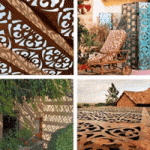
Parasoleil is making panels from recycled and reclaimed materials, mostly copper. (Green certified) These panels come in all different designs and colors. The different patterns on each panel creates a unique shadow affect against the sunlight. Its various uses range from an overhead canopy for your outside patio, to fences, railings, and arbors. Light reflects through these cut outs in the design, making shadows of the shapes. It will give an additional flare to any space, whether you are using it for fencing outside around the pool or dividing some rooms inside. Its multiple purposes provide shade and a beautiful design for your garden.
How is Copper Eco-Friendly?
- Durable- Made to last in your backyard!
- Preventing landfills from overflowing!- When thrown into landfills, this metal can be harmful when it seeps into the ground water. So by recycling and reusing it, we are helping to save landfills.
- Easily shaped and molded-popular choice for construction and architecture
- Fully Recyclable
Submitted by guest blogger, Nicole
Tags: Building, CO
Posted in Building | No Comments »
Eco Friendly Trade Show Booths
Written by Cathy on February 26, 2010 – 8:23 am -
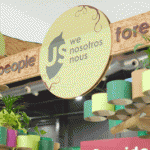
US Forest Delegation, World Foresty Congress,Buenos Aires, Argentina
Being a business owner, sometimes you just have to attend and exhibit at trade shows. If you are a green and eco friendly business it is important that your booth represents your passion and dedication to the environment. The choices you have as a business owner for exhibit booths 1.) buy used 2.) Make your own (if you have time 3.) Rent a table (expensive) 4.) Look for an eco friendly booth builder, who are hard to find. Not only that, trade show booths after about 5-8 years can get pretty beat up and who wants to showcase their products and services with a beat up booth?
Fortunately a Boothster, has come to the rescue for those of us who have to exhibit at trade events. How eco-Friendly? 1.) They buy local 2.) They recycle 3.) They salvage for materials 4.) They use recycled cardboard tubes and FSC certified soy plywood instead of aluminum (all biodegradable) 5.) Graphics are made with soy ink or non-VOC inks.
They make everything you could possibly use for an exhibit booth from banners to tables. I love the booth they did for the US Forest Delegation in Argentina! Fun, interesting and fully recyclable!
Tags: Eco Office, Events, Used Building Materials
Posted in Business | No Comments »
Save Money and Environment: Rent A Green Box
Written by Cathy on February 24, 2010 – 7:46 pm -Submitted by guest blogger Nicole
Moving can waste a lot of resources: money, time, and boxes. Over 20% of the American population moves each year. That’s a lot of boxes being jam-packed into landfills.
Avoid the boxes and the haste of finding them by renting containers from rentagreenbox.com. Yes, I said rent. Spencer Brown, the owner and creator, came up with this great idea: the Recopack. Customer’s can rent plastic containers made from recycled trash found at landfills. Make a call, and Rent A Green Box will drop off your Recopacks and then pick them up 2 weeks later. With these zero-waste plastic containers, they have better durability then cardboard. No more having to deal with crushed boxes. This company has thought of it all; even the trucks used for deliveries is fueled from wasted vegetable oil. As of now, they service Orange County, Los Angeles County, and selected areas of San Diego County.
So skip the hustle of trying to find cardboard boxes, save the landfills from being filled up with wasted material, and Rent A Green Box.
Tags: Reuse
Posted in Green and Save | 1 Comment »
Sustainable Landscaping By EcoLandscape Group
Written by Cathy on February 24, 2010 – 7:46 pm -
Reduce Carbon Footprint
I have written quite a few articles on native plants and gardening. Living a a drought and water rationing state, (California) saving water is a huge prioirty. It drives me crazy when people do not pay attention to their sprinklers on in the rain, water cascading down the street, over-watering and planting of thirsty plants.
As a person who has planted native plants in my yard, I will tell you it is not easy to do. First 1.)you have to find the plants and or a person that knows about the plants 2.) Plant the plants appropriately in areas so they will grow and look good. 3.) If you have a gardener, you have to tell them how to treat the plants 4.) You have to re-adjust your mind to watering schedules and toxic pesticides. 5.) Get over what you neighbors have planted and what is only available at Home Depot. And I will tell you I have spent countless hours on the Internet, with gardeners and nursuries looking for the right look, the right plants for the right soil and sun conditions in San Diego.
If I had known at the time about Eco Landscape Group , it would have saved hours of work and I would have had a sustainable, eco-friendly
yard by now. Eco Landscape Group, started out as 3 friends to refer to each other about residential and commerical landscape design, build , maintenance and horticultural services. Now they have evolved into a group that not only can design a sustainable landscape but help lower carbon footprints and thus reducing environmental impact.
Primarily located in the Northwest, they just added a few members in Jackson Hole, Wy, and are looking for like minded others who are seeking guidance and help in helping their companies achieve a sustainable way of doing business.
The goal ‘To spread our message to locations across the United States offering customers and professionals the first definitive guide to carbon footprint reduction for the American landscape industry’
That is a wonderful goal to achieve and look forward to hearing more about the Eco Landscape Group
Tags: Garden
Posted in Garden/Landscaping | 2 Comments »
Choonimals- Action Sport Clothes That Give Back And Made In The USA
Written by Cathy on February 23, 2010 – 8:06 pm -
Choonimals T-shirts
Eco Friendly Action Sport Week At Green Eco Services. A couple of weeks ago, I had the opportunity to go the the Action Sport Show here in San Diego. This week I will be featuring some of the new eco friendly and green products that are available for those ‘action sport’ minded greenies.
Walking along the aisles, Choonimals T-shirts struck me immediately, I loved the T-shirts, trendy enough for any age group or whether you are action sport minded! Choonimals are made in United States by American Apparel Shops.
Why they are eco friendly:
1.) Made in USA- local company, reducing carbon footprint.
2.) Give back- are in partnerships with Develop Africa a not for profit organization that promotes sustainable development in Mozambique and Casa de la Sal, a Mexico City orphanage.
I think you can intrepret the Tees in many ways, one part is funky fun and the other part is if we don’t stop getting toxin control over our oceans and land, the animals

Shoonimals- Marine Life
will all be warped like the ones shown on the T-shirts. No matter what, they are fun, creative and somewhat wacky and perhaps that is why I like them!
To view more about the chooettes try visiting their blog, definitely worth spending some time browsing, fun, everything from a video to Mt. Kilamajaro to music. Their give back programs are also on the blog, and be sure to visit and see what they to support sustainability in Africa and Mexico.
Tags: Eco Chic
Posted in Eco Chic | No Comments »
San Diego’s MomKidsBiz.com Makes Organic Clothes and Products
Written by Cathy on February 23, 2010 – 8:05 pm -Submitted by guest blogger Nicole
San Diego Company, MomKidsBiz.com, is Making Bamboo Clothes and Products

Organic Cotton Blanket
MomKidsBiz.com has clothing and merchandise that covers it all, from baby to mom to family. This company is making a conscious effort to help save the environment by using organic bamboo, hemp and organic cotton. The merchandise produced by this company is mainly targeted at dads and moms with busy schedule.
Momkidsbiz.com is a one stop shop for the whole family, with products that you know are healthy for your family and the environment. Along with clothes, they also have reusable bags made from biodegradable materials, bamboo fiber towels and sheets, and other every day life products. Their main office is located in Poway,CA, but they ship nation wide.
Why Bamboo?
- It is a sustainable resource.
- Feels just like cotton- You wouldn’t even know that they were made from a different material.
- Washes just like regular cotton- doesn’t require any special washing techniques.
- Popular resource- Bamboo is the world’s fastest growing plant and does not require the use of added fertilizer or chemicals to grow.
- Environmentally friendly!-releases almost 35% more oxygen into the air than trees.
Why Hemp
- Most durable of natural fibers
- Easy to grow- requires little water, no pesticides, and less expensive to farm.
- A great alternative for clothes- creates strong and lightweight clothing. Great for outdoors!
Tags: Eco Chic
Posted in Eco Chic | No Comments »
Voting For Hemp- FAQ’s
Written by Cathy on February 22, 2010 – 7:29 pm -I did not write this, but please visit the website for more information on Hemp!
Vote Hemp http://votehemp.com/ is a national, single-issue, non-profit advocacy group founded in 2000 by members of the hemp industry to remove barriers to industrial hemp farming in the U.S. through education, legislation and advocacy. We work to build grassroots support for hemp through voter education, registration and mobilization, as well as defend against any new laws, regulations or policies that would prohibit or restrict hemp trade.
Industrial hemp is the non-psychoactive, low-THC, oilseed and fiber varieties of the Cannabis sativa plant. Hemp has absolutely no use as a recreational drug.
The Vote Hemp Treatise
A Renewal of Common Sense: The Case for Hemp in 21st Century America was written in 2001 by Erik Rothenberg, President of Atlas Corporation and a director of Vote Hemp, with the assistance of various industry experts. This treatise lays out a clear vision for industry and agriculture and hemp’s critical place in a healthy and prosperous new world.
If you are pressed for time, we particularly recommend reading the sections The Market for Industrial Hemp (pp. 10-16) and Hemp vs. Marijuana — Rhetoric vs. The Reality (pp. 17-22). The former section outlines in depth the tremendous potential hemp fiber and seed have in diverse markets, which is important to understand in the face of government propaganda to the contrary.
The latter section clarifies that non-drug industrial hemp is not marijuana although both are varieties of the same species (Cannabis sativa), and refutes categorically the specious arguments traditionally used by law enforcement to justify the prohibition of industrial hemp. Canada, Britain, France, Germany and Spain, along with over twenty other countries, cultivate and process industrial hemp without affecting the enforcement of those countries’ marijuana laws.
The section concludes by showing a rational government precedent in controlling the “opium poppy” from which narcotics like heroin are derived, while allowing non-drug poppy varieties of the same species (Papaver somniferum) to be cultivated freely in backyard gardens and the seeds of the “breadseed poppy” variety to be consumed commonly on poppy seed bagels. This is an absolute must-read document! To read A Renewal of Common Sense: The Case for Hemp in 21st Century America online please click here.
To download a copy, click here. (PDF file 63k)
The Vote Hemp Report
The 28-page 2002/2003 Vote Hemp Report summarizes industrial hemp’s progress in various seed and fiber markets, and details the current state of hemp in North America. It is a great educational tool which covers the gamut of hemp markets and features ads from many of North America’s top hemp companies. For more information, click here.
Common Misperceptions About Hemp and Easy Answers
Want to know the difference between hemp and marijuana? Ask an expert. Dr. Dave West holds a Ph.D. in Plant Breeding from the University of Minnesota and has spent 18 years as a commercial corn breeder. Since 1993 he has served as an advisor to the emerging hemp industry regarding industrial hemp germplasm. His 1998 document Hemp and Marijuana — Myths and Realities provides straight facts about industrial hemp and dispels some of the myths surrounding it. To view a copy, click here. (PDF file 79k)
Congressional Research Service Report on Hemp
In January of 2005, the Congressional Research Service (CRS) issued a new report on the industrial hemp marketplace and legislative efforts to allow hemp farming in the United States. “Hemp as an Agricultural Commodity” is a comprehensive report on the status of U.S. industrial hemp policy and highlights the fact that America is the only developed country to ban farmers from growing non-psychoactive industrial varieties of Cannabis. The CRS report has been updated twice since January 2005. To download the March 2007 version of the report, please click here. (PDF file 100k)
Hemp is Hip, Hot and Happening: So Why Are American Farmers Being Left Out?
This special section appeared in the September-October 2004 issue of Utne magazine and offers a great summary of why we need to reconsider industrial hemp. To read the article, click here.
State Hemp Legislation
Fourteen states have passed hemp legislation, giving significant legitimacy and momentum to the hemp movement in America. The first hemp bill was introduced in Colorado in 1995, and 28 states have considered industrial hemp legislation. To view a list of state action on industrial hemp, as well as U.S. federal legislation and Canadian federal regulation & legislation information, click here.
National Association of State Departments of Agriculture Adopts Pro-Hemp Resolution
The National Association of State Departments of Agriculture (NASDA) passed a resolution in 2003 urging the U.S. Department of Agriculture, the Drug Enforcement Administration and the Office of National Drug Control Policy (Drug Czar’s office) to collaboratively develop and adopt an official definition of industrial hemp, and urged Congress to statutorily distinguish between industrial hemp and marijuana and to adopt policies which would allow U.S. farmers to grow industrial hemp. For more information and to read the resolution, click here.
National Conference of State Legislatures Adopts Pro-Hemp Resolution
The National Conference of State Legislatures (NCSL) adopted a resolution in 2000 strongly urging the U.S. Department of Agriculture, the Drug Enforcement Administration and the Office of National Drug Control Policy (Drug Czar’s office) to collaboratively develop and adopt an official definition of industrial hemp. This is a strong statement for common sense as the NCSL is widely respected and regarded for its conservative and prudent approach on a variety of issues. Click here to read the letter that NCSL wrote to President Clinton in support of industrial hemp. Click here to read the NCSL industrial hemp resolution. (PDF files 64k and 4k, respectively)
Letter from Hawaii Legislators to President Bush
A bi-partisan group of Hawaii state legislators sent a letter to President Bush in 2001 informing him that “… industrial hemp is a state agricultural issue, not a drug issue. Banning hemp products intended for consumption will negatively impact industrial hemp manufacturing and production, thus impairing America’s farmers and manufacturers. In light of the growing support of state legislatures for industrial hemp, it is timely and essential that the federal government remove barriers to its cultivation and production.” To read the letter, click here. (PDF file 469k)
Evaluating Interference of THC in Hemp Food Products with Employee Drug-Testing — Study Summary
Leson Environmental Consulting conducted a toxicological study in 2000 to evaluate the potential conflict between extended consumption of hemp food products and workplace drug-testing programs in the United States. The study’s findings indicate that the following measures will be effective in virtually eliminating interference between consumption of hemp food products and workplace drug-testing:
- Adherence by hemp food processors to seed cleaning and quality control measures aimed at limiting concentrations of total THC to 5 µg/g (or ppm) in hemp oil and to 2 µg/g in hulled seeds.
- Adherence of U.S. employers and administrators of drug-testing programs to guidelines for federal programs, requiring that urine samples that fail a screening test be confirmed by GC/MS.
Most major U.S. and Canadian hemp food processors are currently adhering to these standards through participation in the industry’s TestPledge program. To view a summary of the study, click here. (PDF file 21k)
Assessing the Impact of THC Uptake from Hemp Oil Cosmetics on Workplace Drug-Testing
Leson Environmental Consulting also evaluated the concern that extended topical application of hemp cosmetic products would interfere with workplace drug-testing programs in the United States. The 2001 study shows this concern to be baseless, as no significant transdermal uptake of THC would occur even in a worst-case scenario of highly compromised skin and full-body application of hemp oil containing 10 ppm THC (the maximum limit allowed by Canadian law, while 5 ppm THC in hemp oil is in fact the informal industry standard). To view the assessment, click here. (PDF file 277k)
USDA Research Shows Hemp Has Potential for Paper Production
In 1997, the USDA Forest Products Laboratory in Madison, Wisconsin conducted an evaluation of hemp as a potential feedstock for the paper industry in that state. They concluded that “… hemp could profitably be used as a fiber source for the paper industry” and that “Wisconsin farmers could meet the demand for fiber by the fine paper manufacturers of Wisconsin.” To view the report, click here. (PDF file 569k)
DEA Eradication Efforts Target Hemp Instead of Cultivated Marijuana
The Vermont State Auditor’s Report on the Domestic Cannabis Eradication/Suppression Program (DCE/SP), published in 1998, found that the national average for ditchweed seized under the DCE/SP in all 50 states was 99% as of 1996. The study notes that over $9 million was spent on this program in 1996 and that out of 422,716,526 cannabis plants eradicated, 419,660,022 were low-THC ditchweed, also known as industrial (feral) hemp. The report recommends that policymakers who are concerned that the federal cannabis eradication program focuses so heavily on wild industrial hemp consider lobbying the DEA to change the DCE/SP grant to target cultivated cannabis more exclusively.
This report indicates that millions of our tax dollars are wasted on eradicating harmless low-THC industrial hemp plants instead of focusing on the eradication of cultivated marijuana. More recent 2001 statistics show that more than $13 million in taxpayer funds were spent on this boondoggle program. To view the full report, click here. (PDF file 79k)
Tags: Eco Chic, Green business
Posted in Business | No Comments »
Volcom- V.co-logical Challenge- Win $1000 With ECOmmercial
Written by Cathy on February 22, 2010 – 6:59 am -
Volcom Leaf ECOmmercial Contest
While not their full line of Volcom’s action sport clothing and equipment is considered eco-friendly, they have started producing organic clothing known as the v.co-logical series. To further promote their sustainability, they even have a Give Back Blog, which provides updates on how they give back, the steps they are doing to minimize the impact on the environment plus listings of events and charities.
Now until April 9th for any Orange County Hight School Students, Volcom is issuing an ECO-Challenge for students to participate and Win up to $1000 in prizes! All they have to do is create a Public Service Announcement for an ECOmmercial! For more information you can visit www.volcom.com/leaf . Students are challenged to create a 30-60 second eco awareness commercial in their own words. Great opportunity for budding videographers!
Winners will be recognized by leaders in the entertainment industry- Ed Begley especially.
I have always liked Volcom products and sometimes I think that is all a couple of my nephews wear! Everything Volcom and they don’t even skateboard or surf!
Tags: Eco Chic
Posted in Eco Chic | No Comments »
DirtBall Fashion- T-shirts Made With Water Bottles
Written by Cathy on February 20, 2010 – 7:32 am -
Dirtball Sign Made With Cardboard
I’m still wandering the aisles at the Action Sport Retail Show, and once again I am impressed! Dirtball Fashion (http://dirtballfashion.com) insteading of wasting energy, oil- reused cardboard, made their back-drop sign from cardboard. It was eye-catching and I loved it! Not only that each Dirtball T-shirt is made from bottles! Plus for every Dirtball Tshirt sold they donate $1.oo to a charity of choice.
Dirtball Tee are American made and all products are sourced within 200 miles of Dirtball’s home office. Plus their goal is Zero Impact and Zero Waste.
They make recycled T’s, hats, pants, jeans, fleece, soft shells, outerwear, skatedecks and snowboards and shorts, quite a diverse offering. Men, Women and Childrens clothing are available.
You can also visit them on Twitter, myspace, facebook, Loop’d, YouTube, FuelTV.-
Facts on Dirtball Material (from website)
Each Dirtball T-shirt contains 2 – 16oz. water bottles.
Dirtball’s current short “The Dirt Short” – is made out of 10 16-ounce bottles, which have been repurposed to create a high-quality polyester fabric. The shorts are not only recycled, but recyclable. Once a pair is worn out it can be returned to Dirtball Fashion where it gets sent back to their North Carolina headquarters to be re-spun back into polyester fiber. To thank the customer for their environmental friendliness, the customer will receive 20% off a future on-line purchase. No other clothing company has a recyclable short.
- All shirts printed with water based ink.
- 2 million plastic bottles are used in the U.S. every 10 minutes.
- 51 billion plastic bottles go into U.S. landfills every year.
- 3 billion plastic bottles recycled is the equivalent of saving over half a million barrels of oil and eliminating 400,000 tons of harmful air emissions which contribute to acid rain, global warming and smog.
- Recycling pre-consumer cotton helps to keep 5 billion pounds of waste from going into U.S. landfills.
- Buy buying fabric made with recycled cotton, you are helping to reduce the effects of insecticides and other chemicals have on our soil, air and water tables.
- It takes 1/3 lb of agricultural chemicals to produce 1 cotton t-shirt.
- Cotton requires 22,000 liters of water to produce 1 kilogram of cotton lint making it the most fresh water intensive crop in the world.
- Cotton uses some 25% of the world’s insecticides, even though it is grown on 2.4% of the world’s land. Cotton consumes 60% of the insecticides applied in the U.S.
- Recycled cotton doesn’t take the manual labor or land use that is required for conventionally grown cotton. It takes twice as much land usage to produce the same amount of organic cotton as conventionally grown cotton.
- The majority of the organic cotton is produced in Asia and shipped to the U.S. offsetting any environmental benefits due to the transportation resulting carbon footprint.
Tags: Eco Chic
Posted in Eco Chic | No Comments »
Catoosa County Sick of Ilegal Dumping- Georgia Cost of Litter=$14 Million
Written by Cathy on February 20, 2010 – 7:31 am -Catoosa County is educating public on illegal dumpinghttp://www.walkermessenger.com/view/full_story/6406010/article-Catoosa-County-is-educating-public-on-illegal-dumping-?instance=secondary_stories_left_column by Mark Andrews
Chuck Taylor, roads department director for Catoosa County, said nearly 75 percent of people driving to the county landfill do not have their load of garbage properly secured or covered, resulting in roadways being littered. Under state law, that’s dumping illegally, he said.
“It’s partially because people aren’t properly securing their vehicles and items will fall out,” Taylor said about the littering problem.
But also “it’s partially a sign of the economic times. People are choosing to dump anywhere,” he said.
Taylor said “problem” areas include Poplar Springs, Oak Tree and Dedmon roads.
He said a major problem is the illegal dumping of tires, with 40 tires recently found on the roadway in a single pile.
He added that three sofas were recently found in three different areas.
In order to cut down on littered roadways, the public works department, as well as sheriff’s deputies, will be at the county landfill Saturday, Feb. 20, from 8 a.m. until noon and on Monday from 8 a.m. until 3 p.m. in an effort to “educate” citizens on the legal and financial repercussions of littering.
For example, any amount of biomedical or hazardous material dumped on a state roadway is considered a fel-ony, resulting in a fine of up to $25,000 and/or a prison term of up to five years.
Also, an arresting officer may impound a person’s vehicle in the case of any litter that exceeds 10 pounds or 15 cubic feet.
Taylor said the department will be handing out brochures at the landfill with information ranging from the proper way to secure a vehicle, to the financial cost due to state litter violations.
He said the sheriff’s department will be making its presence known and will begin issuing tickets and citations for those who are violating the state law.
According to a pamphlet by the Georgia Department of Community Affairs, the state Department of Transporta-tion has spent $14 million in a single year picking up roadside litter.
“What people don’t realize is that this costs taxpayers thousands,” Taylor said. “First, (taxpayers) are paying for labor costs to have the litter removed. Then they’re paying to have the litter dumped. It’s costing them twice — plus, it’s illegal.”
Tags: GA, Pollution
Posted in Georgia | No Comments »