Organic Product Sales Up

Written by Cathy on May 31, 2009 – 11:54 am -

Welcome back!

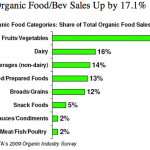
According to The Organic Trade Association  U.S. sales of organic products, both food and non-food, reached $24.6 billion by the end of 2008, growing an impressive 17.1 percent over 2007 sales despite tough economic times, according to the Organic Trade Association (OTA), which today made available final results from its 2009 Organic Industry Survey.

While the overall economy has been losing ground, sales of organic products reflect very strong growth during 2008. “Organic products represent value to consumers, who have shown continued resilience in seeking out these products,” said Christine Bushway, OTA’s Executive Director.

The survey, conducted by Lieberman Research Group on behalf of OTA, measured the growth of U.S. sales of organic foods and beverages as well as non-food categories such as organic fibers, personal care products and pet foods during 2008. Results show organic food sales grew in 2008 by 15.8 percent to reach $22.9 billion, while organic non-food sales grew by an astounding 39.4 percent to reach $1.648 billion. As a result, organic food sales now account for approximately 3.5 percent of all food product sales in the United States.

This marks another milestone for the organic food market,” said Bushway.

With tough economic times, consumers have used various strategies in continuing to buy organic products. Because most venues now offer organic products, consumers have the opportunity to shop around. Increased use of coupons, the proliferation of private label brands, and value-positioned products offered by major organic brands all have contributed to increased sales.

The final report of the Organic Trade Association’s 2009 Organic Industry Survey is now available for purchase. Orders can be placed online at http://www.ota.com/bookstore/2.html.

Note: The report’s Executive Summary is available to members of the media on request from the contacts listed above.

The Organic Trade Association (OTA) is the membership-based business association for organic agriculture and products in North America. Its 1,600 members include growers, shippers, processors, certifiers, farmers’ associations, distributors, importers, exporters, consultants, retailers and others. OTA’s mission is to promote and protect the growth of organic trade to benefit the environment, farmers, the public and the economy (www.ota.com).


Tags: ,
Posted in Food and Drink | No Comments »

Win $20,000 with Your Green Idea!

Written by Cathy on May 31, 2009 – 11:45 am -


DEADLINE JUNE 8, 2009

Want to make a environmental difference in your community or neighborhood? Sun Chips and National Geographic have combined forces and will be awarding $20,000 to 5 people or groups that have the best ideas for ‘Green Change”. 

What you have to do:

Submit  a description of your Green Effect Idea by June 8, 2008. (Submit on line here) 

Finalist will be announced July 7, 2009!


Tags:
Posted in Events | 1 Comment »

8 Green-Eco Friendly Resources in Mexico

Written by Cathy on May 30, 2009 – 8:51 am -


l Iove Mexico and wondered if there was any ‘green blogs’ about Mexico. There doesn’t appear to be much- most are eco Tourism sites- but since I did the research- thought I would share it anyway. Not all the sites are ‘Green’ but gives you a starting point. I use the map, because I cross off all the places I have been! Me amo Mexico! 

Eco Friendly Mexico

8 Green-Sustainable Blogs and Resources in Mexico 

  1. Mexico Blogalaxia I had Google translate the page to English 
  2. Quilting Blogs from Mexico 
  3. Best Mexico Blogs 
  4. Mex Experience
  5. The Temas Blog- Consumer, Environmental and Health policie in Latin American and the Caribbean. 
  6. Baja Trash
  7. Green ExplorerGreen Explorer works with its partners to provide sustainable tips and advice on how to live green and travel clean. Share your experiences and ideas here and help make a world of difference.
  8. Planeta 

Tags:
Posted in Eco Tourism | 1 Comment »

Composting 101- Easy Tips for Beginners

Written by Cathy on May 30, 2009 – 8:35 am -


Why Compost:

  • Each American has 1200 pounds of compostable organic waste annually
  • Fills Landfills
  • Processes of Natural decay lead to the production of methane
  • Making and using your own compost- frees you of petroleum derived synthetic fertilzers
  • It takes about 2.5 gallons  of gasoline to produce 140 pound bag of fertilizer
  • Saves Water- Compost helps to retail moisture, reduce evaporation and prevents water run-off

What to Compost:

  • Lawn and yard clippings that are pesticide free
  • Food leftovers, eggshells,
  • Paper products, including cardboard rolls, tissues, paper towels, coffee filters,
  • Pet Fur
  • Wood Ash in small amounts

What not to compost

  • Animal or meat by-products
  • Dairy, grease, lard, oils, fish waster
  • Pet Waste

What You Need

  1. You don’t actually need a designated bin if you want to make compost; a well-tended, simple pile in your backyard will be sufficient.
  2. If that is not possible indoor and outdoor compost bins conceal waste piles odors they may emit and keep animals from rummaging through your food scraps.
  3. Compost bin may be kept clean with compostable, starch-based liners

Determine Size

Before you buy, determine what you’ll be composting- food scraps only or lawn and garden clippings as well. The more you compost, the larger the composter should be. Composting leaves and lawn clippings, (3 cubic feet, which will give you enough finished compost to cover 324 sq. ft. with 1 inch)

Determine Material

The most common material for composters and compost bins is plastic. Therefore, look for the highest percentage of recycled content you can find. Avoid those made with polyvinyl chloride (PVC), which releases carcinogenic dioxin into the atmosphere when it’s manufactured and incinerated.

Ceramic compost pots blend in nicely with your personal decor if you need a small container to gather compostable materials indoors.

Maintenance 

  1. Keep a healthy nutrient balance and avoid odors by blending a 2-to-1 ratio of carbon-rich “brown” items such as leaves, twigs and bark with nitrogen-rich “green” items like grass clippings and food wastes.
  2. Keep slightly moist, and
  3. Keep aerated with rotating compost bins or manually turning about every 2 days. The more frequently the pile is turned the more rapidly materials will decompose 
  4. Mix your  native soil from your yard or garden into the mix is essential for introducing native organisms.
  5. Compost is “finished” before application, (dark in color, and smell earthy)  
  6. Leave unused compost in the pile.

Applying Compost

  1. To determine how much compost is needed for lawns and garden beds, multiply the square footage of the area to be treated by the thickness that will be applied.
  2. A 3- to 4-inch layer of finished compost can be worked into the tops of garden soil before planting in spring or late fall, or a handful can be transplanted into the hole before planting annuals and perennials.
  3. A half-inch of compost can also be applied as a top dressing to lawns in the spring and fall and for shrubs and garden plants several times a year.
  4. For a flower bed containing existing perennials, estimate the area that those plants occupy when determining how much compost is needed. If half the area is already covered with plants, you’ll need half as much compost.
  5. Mix one part finished compost with two parts soil for a nutritious potting mix for houseplants. When planting seeds, use less compost and more soil to allow roots to take hold firmly.

Resources: EPA- Compost


Tags: ,
Posted in Garden/Landscaping | No Comments »

Community and Urban Gardening

Written by Cathy on May 30, 2009 – 6:38 am -

Community Garden- Los Angeles

Since I have just torn up my whole yard to hopefully get rid of the bamboo- I was thinking I should plant a garden instead. Unfortunately where the yard is torn up- is very shady and not a great planting ground for a garden. 

A few of us at our HOA association would love to take some of the ‘greenbelt’ area and make a community garden. That is not going to happen with our current board members, but if you love to garden or want to learn to garden, grow your own food you might consider joining a community garden. 

Community Gardens promote 1.) healthy eating 2.) food security 3.) sustainable and effective use of space 4.) community togetherness 5.) recreational opportunities 6.) community education. 

Find a Community Garden 

Local State Community Garden Resources 

To Grow Your Own 


Tags:
Posted in Garden/Landscaping | 4 Comments »

More Free Stuff- Really, Really

Written by Cathy on May 29, 2009 – 9:42 am -

I think we all know about Craiglist, Free Cycle, then there was Giving Away and now a new concept  Really Really Free Markets 

They are connecting people with other people giving away free stuff. According to RRFM there is enough for everyone and we should share rather than letting good stuff go into landfills! 

Check out this site as there are RRFM all over- in Texas, Washington, San Francisco. Sounds interesting and I will definitely check them out, next time I am in San Francisco.


Tags:
Posted in Recycle | 1 Comment »

Clear Up Pollution and Budgets At The Same Time

Written by Cathy on May 29, 2009 – 9:28 am -

Here is what I think- all these states and in particular my home state of California have dire budgetary problems- Yesterday I saw 2 cars idling away- no ticket. Think of how much money we would save if the following happened:

1.) Every person who was not using a headset when using the phone and driving actually got a ticket. 

2.) People that littered actually were stopped and fined! 

3,) Greenbelts owned by HOA’s were actually fined for all the litter they produce. 

4.) Schools- charged parents for litter from their children- and charged athletic teams for litter pick up after the games. 

5.) Overwatering by HOA’s were fined. 

6.) All those GARAGE SALE SIGNS- still up 24 hours after the garage sale- fined again. You have the address! 

If I see this everyday when I walk- some cop- police officer and sheriff also sees this. Not only could we stop the problem of litter, we could save millions of dollars in litter pickups! 

E- Magazine 

New York City is cracking down on excessive vehicle idling in its aggressive statewide campaign known as the Stop Smoking Initiative for Trucks. Emissions from diesel-engine vehicles contain sulfur dioxide, particulate matter and nitrogen oxide, creating ground-level ozone that contributes to hundreds of thousands of asthma attacks in the U.S. each year.


Getty Images

Currently, NYC has a three-minute idling limit that targets all vehicles, with certain exceptions. But the New York State Department of Environmental Conservation (NYSDEC) has taken the matter to the streets by setting up so-called “enforcement actions” in heavy truck “hot spots” and issuing tickets to violating offenders. So far, the NYSDEC has committed to performing one operation per month in one of the five boroughs. And city residents can take part in the crackdown by calling 311 to report excessive idling.

The initiative comes on the heels of a successful city-state crackdown on truck and boiler pollution conducted in October 2008 in East Harlem, a neighborhood clouded by poor air quality caused by heavy truck traffic. During the operation, NYSDEC officers together with the New York City Department of Environmental Protection issued 43 tickets for excessive idling and an additional 163 tickets to diesel truck operators for various air and safety regulation violations.

The Empire State is not alone in its efforts to curb idling. Since there is no national anti-idling law, 15 states, including California, Maryland and Connecticut, and a number of local communities have created their own anti-idling laws. According to the American Transportation Research Institute, fines for excessive idling vary widely by state, ranging anywhere from $100 up to $15,000 for a first-time offense.


Tags:
Posted in Pollution | No Comments »

Cool Eco-Friendly Camping Gadgets

Written by Cathy on May 29, 2009 – 9:09 am -


A great way to reduce your air miles is to enjoy your local environment and go camping. Camping is hugely popular, and it’s a great way to appreciate nature, have a fun holiday and spend time with your family. To ensure your camping trip is as eco-friendly as possible, here are a collection of green camping gadgets to peruse.

If you’re away from home, you still need to stay clean, so how about an eco-friendly solar shower?

You fill up the bag with up clean water, and then the sun’s energy will heat up the water thanks to the black colouring of the bag. No fossil fuels, fires or electricity is needed! The shower bag itself is also eco-friendly, because it contains no harmful chemicals. 

Solar Camping Shower

A conventional domestic toilet uses a great deal of water, but if you’re out camping, you might have a chemical toilet, or perhaps a cosy spot behind a tree! Thanks to a novel use of cardboard, you can use a sh*tbox.

Camping Stool (no pun intended)

It’s basically a biodegradable toilet where you bury the inner bags in the soil. Over a few days, your waste will breakdown naturally without the need for water or chemicals.

You’ve got to drink, and water is pretty good quality in most western countries. However, if you’re travelling in the middle of nowhere, you won’t have the luxury of fresh clean running water. A clever invention called the SteriPEN allows you to purify your water in remote locations. The SteriPEN uses shortwave ultraviolet light which damages the DNA of bacteria, viruses and protozoa, rendering them harmless. It takes less than a minute to sterilise half a litre of water, and a single charge of batteries can sterilise over 100 litres!

Water De-Toxifer

This is a guest article by Dan Harrison who writes about eco-friendly gadgets for EnviroGadget.com. You can read about more eco-friendly camping gadgets and other green gizmos at EnviroGadget.com.


Tags:
Posted in Sports | No Comments »

How Greenly We Rate- Greendex

Written by Cathy on May 29, 2009 – 6:05 am -


2009-The  2nd Annual  Greendex’ survey by National Geographic released. Greendex, a worldwide environmental tracking survey  to measure consumer behaviors that have an impact on the environment. GlobeScan found an increase in environmentally friendly behavior in 13 of the 14 countries surveyed. 

Overall the scores were good news, whether or not it was due to the economy, who really knows. Economic conditions have definitely limited consumption, however people are becoming more aware of environmental concerns and issues. Consumers are being alerted about things they can do easily to save money and the environment. 

It’s an interesting study- with an interactive map- just click on your country and find out how your country rates.


Tags:
Posted in Environment | No Comments »

Rape Free Products Interview with Eve Ensler

Written by Cathy on May 29, 2009 – 5:42 am -


In the Congo, according to Eve Ensler, the miltary uses rape and sexual violence to fracture communities, employ slave labor to mine coltran which is used to produce capacitors that power cell phones, iPods and other gadgets. Over 5.5 Million killed, Very interesting interview- please check it out. 

To view the interview- click here 


Tags:
Posted in Organizations | No Comments »